Feature / Olive Tree, Croissants, Dates — and Coma
In the Djaafer family card game , I ask for the mother. An Algerian former midwife, Louiza now lives in the south of France with her six children: Kaouthar, Asma, Maria, Amira, Kenza, and Zakary. However, it is impossible not to mention Laya, the daughter of the eldest, who today embodies the hope of their mother’s awakening. A few months ago, after a surgery went wrong, Louiza’s life was shaken, sending her whole family into worry and fear. I came to visit them and wanted to look back at this crucial time in their lives, a moment when, in that same game, her daughters would have had to answer “Not at home.” Amidst double culture, immigration, religion, and familial love, those five days of coma transformed this family, who, after coming so close to losing their mother, continue to celebrate life.
Sunday, 20th of October 2024, France.
The blankets are piling up in Louiza’s living room. Forming a cozy stack where she sleeps against Laya, Amira, and Kenza, her two-year-old granddaughter and her two 19-year-old twin daughters. Although there are beds for everyone in this lively house, the mom prefers this simple comfort: that’s how it was done in her childhood in Algeria.
The sun hasn’t risen yet when Louiza wakes up. She mutters a few words in Arabic, likely a prayer, as she slowly sits up with difficulty. It’s time for Fajr, the first one of the five daily prayers in Islam. She performs her ablutions, and then puts on her white hijab with calm, ritualistic gestures, heavy with fatigue. She is especially gentle as she places the fabric over the fine yet long scar that runs across her scalp. Then she joins her eldest daughter, Kaouthar, to pray together.
About twenty minutes later, the smell of bread, mint, and honey fills the room. “On Sunday mornings, my daughters only wake up when it starts to smell like Algiers market. Ya Allah they’re so lazy,” she says, half-serious, half-joking as she puts as many croissants as the plate can take. “You’re avoiding the subject,” chimes in Asma, her second daughter, appearing in the doorway. “She doesn’t like to talk about that scar and the surgery. It brings back bad memories.” chimes in Asma, her second daughter, appearing in the doorway and referring to the questions I’ve been asking her mother. She is holding Laya in her arms; the little one is barely awake and is sucking on her pacifier. “When the tea is ready, I’ll start telling you,” she says before Louiza cuts her off, playfully : “Come here and learn how to cook instead of talking, or you’ll both end up old maids”.
Breakfast and Memories
Two years ago, Louiza noticed that her vision was deteriorating on the left side. Her second daughter, Asma, insisted she see a doctor. The tests followed one after another: an appointment with the ophthalmologist, then a scan that revealed a meningioma, a benign tumor of the meninges. The doctor had tried to be reassuring: "It's a relatively simple operation, especially for someone your age." Kenza, one of the 19-year-old twins, mimicked him by widening her eyes dramatically.
It’s past 10 a.m., and the whole family is here. Each member joined us gradually as they woke up, and the table kept growing. Each time, Louiza repeated the same thing: "Go wash your face, drink a glass of water and come eat before your sisters finish everything." We've been snacking for about three hours: a piece of bread here, some honey there. "You know the conversation is interesting when we make tea more than five times. Come on, Mom, tell us!" said Amira, washing fresh mint to prepare the sixth teapot of mint tea. "Come on, Mom, continue, you never talk, we’re making the most of it!"
With difficulty, Louiza explained to us that she hadn’t really grasped the seriousness of the situation. Her mind was occupied with much more simple yet deep concerns: taking care of her six children, feeding them, going to see her mother in Algeria. As a single mother of Algerian origin, living in France, her life had been a long series of challenges, daily battles that led her to a rather unique resilience.
On the day of the operation, Louiza was calm. However, things didn’t go as planned. Asma, the second daughter, took over and explained to me while eating dattes that, during the surgery, an artery ruptured, causing a brain hemorrhage, followed by a stroke. Louiza fell into a deep coma that lasted five days, leaving her daughters and loved ones in unbearable anguish. "It was horrible," "I was scared to death," "I love you so much, Mom," "Oh my God!" "Never having real breakfasts again," were some of the phrases I managed to catch from the commotion escaping from these six mouths when the coma was mentioned.
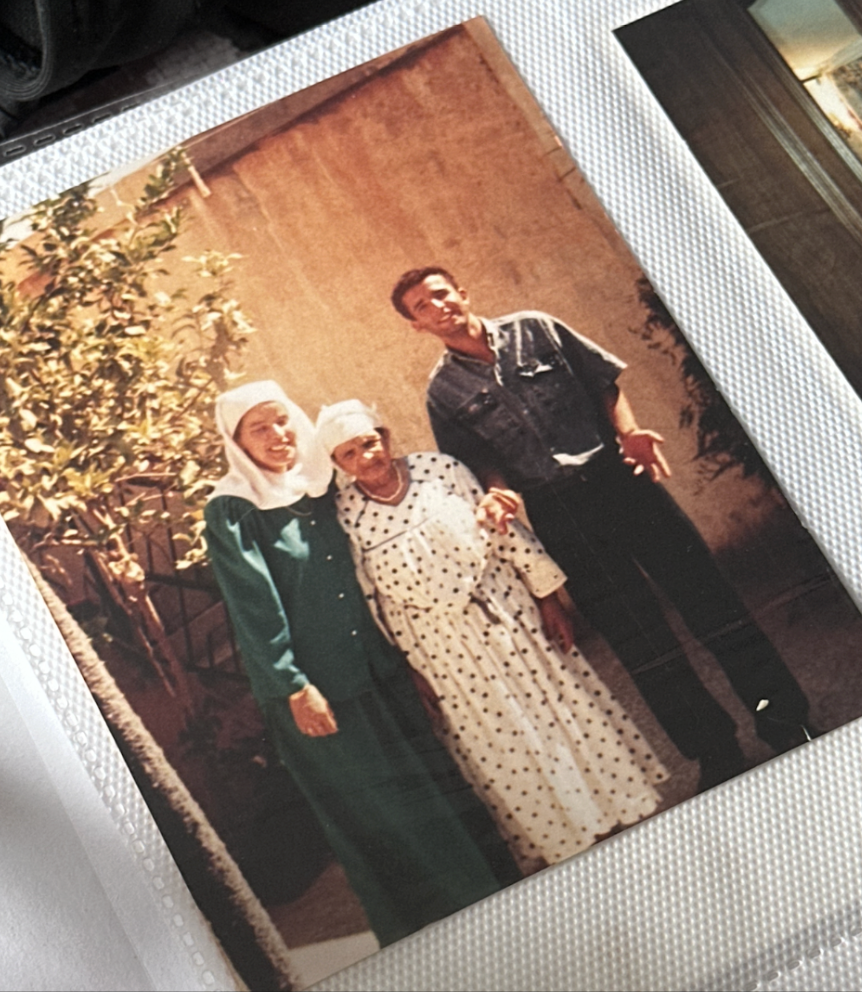
The olive tree, a dream between two realities
" I was in a field, a huge field. Everything around me was green and the grass reached up to my knees.
I couldn’t see myself, I didn’t know what I looked like, or how old I was. I didn’t think about it. All I saw was this enormous tree in front of me.
An olive tree.
So, I walked.
I had been walking for a few minutes when suddenly, I heard my mother’s voice. But I heard it perfectly, as if she were right next to me.
The sound was clear, loud, and precise. She called my name.
She said “Louiza,” without really pronouncing the “L”.
She said it three times with a slight pause in between each time.
“Wiza,”
“Wiza,”
“Wiza,”
then she gently said: “Come on, wake up,” and, I just opened my eyes
This olive tree, in her dream, wasn’t just any tree. ”'In Algeria, olive trees are everywhere,' she said. As a child, she spent her summers harvesting olives in the village of Chlef. Then, in France, she continued this tradition with her own daughters, picking olives during walks in the south of France. In Islam, the olive tree is also a sacred tree. It is mentioned in the Quran, notably in Surah An-Nur, as a symbol of divine light. Louiza saw a spiritual connection: 'It was as if this olive tree in my dream was reminding me of my faith, my roots, my mother, and my granddaughter.
The long wait: a bridge between two cultures
Those five days of coma felt endless for her daughters. During that time of uncertainty, they turned to what they knew best: prayers, the comfort of traditions, and the habits of their mom.
'We took turns going to see her every day,' says Kenza, the youngest of the twins. "We recited surahs in the car, and every day, we would give Sadaqa to Katia.” Katia is a homeless woman, Louiza’s family knows her well, as she often sleeps outside the children’s school. Sadaqa is a charitable donation to the less fortunate, a practice the family regularly engages in. But during times of crisis, intensifying Sadaqas is seen as a way to attract good fortune and divine protection.
"The doctor told us we had to talk to her, touch her, to try to bring her back to consciousness." Kenza, like her sisters, used gestures that reflected this blending of cultures: she recited Quranic surahs at her mother’s bedside. She tearfully confides, "I would read her two Surahs, the first one, Surah Ash-Shifa, for healing, and the second one, the Surah Al-Moulk, also known as the of Death’s Punishment." She explains that in Islam, when a person dies, they face their good and bad deeds while awaiting the Day of Judgment. By reciting this surah, one erases bad deeds, thereby reducing the punishment of the grave. As I hear this, I realize that most of the sisters have tears in their eyes, understanding how close they came to losing their mom.
Then Kenza breaks the tension: 'But nothing worked... except Laya, in the end. You just need big babies with dirty diapers, forget science and religion.' Louiza bursts into loud laughter.
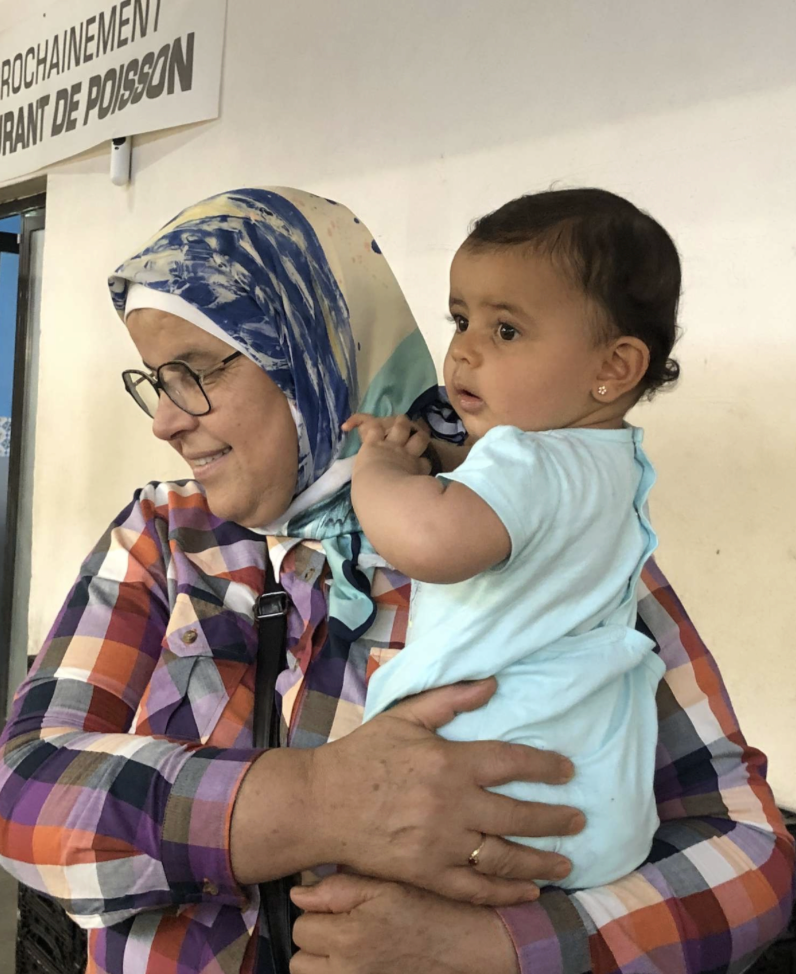
Laya: the newborn at the end of life
The real breakthrough came when Laya, the beloved granddaughter, was brought to the hospital. "That’s when we saw the first sign of a response," says Maria, the third daughter, once we were alone. "Laya brought with her an... energy of life. But more than that, Laya represents a new phase in my mom's life. No more work, no more kids to raise... Laya is the fun of having children without the responsibilities. It's like freedom for mom."
Maria shares a hard truth with me: 'It was probably for Laya that she woke up. That little baby gave her back her will to live. She wasn’t sad or anything, but raising six kids alone, facing racism, Islamophobia, living far from her home country... It's very hard. It’s exhausting. I’ve never told anyone this, but when I was at the hospital, I didn’t really try to stimulate her. I told her that; if she really wants to go, I wouldn’t hold it against her. I’d take care of the little ones, of Laya, of grandma. I remember telling her “Mom, if you really want to go, it's okay. You deserve to rest.”
She smiles as she adds, “But she stayed.”
Post a comment